



 Contact
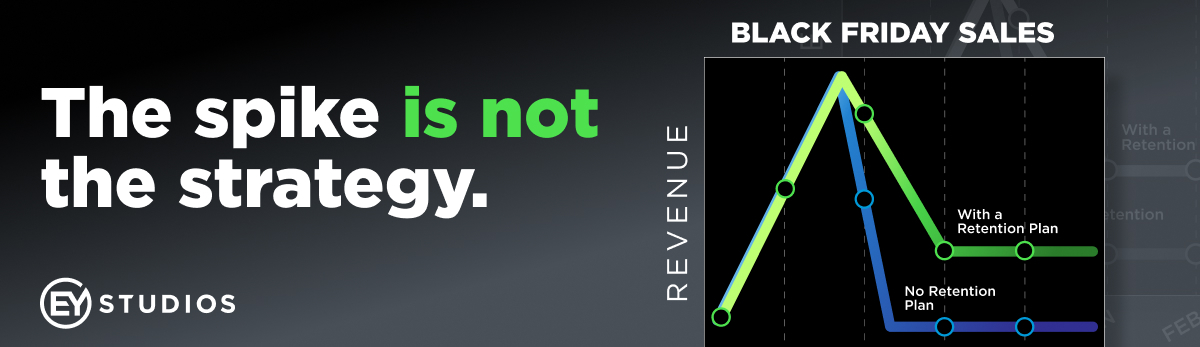
Black Friday is great at attracting customers. The bigger challenge is figuring out how to keep them. Every year, merchants invest heavily in advertising, promotions, creative, inventory, and technology designed to capture as much holiday demand as possible. Traffic spikes, orders pour in, and revenue charts move up and to the right. Then January arrives, traffic returns to normal, and many of those first-time Black Friday buyers are never heard from again.
That’s a significant missed opportunity because the real value of Black Friday isn’t simply how much revenue you generate during Thanksgiving weekend. It’s how many new customer relationships you create that continue producing revenue long after the holiday season is over.
If you’re going to spend aggressively to acquire customers on Black Friday, your marketing needs to account for what happens after that first purchase. Here are three ways to turn more of those Black Friday buyers into long-term customers.
Executive Summary
Black Friday buys you customers. Whether they’re worth anything comes down to what you do in December, which is usually when everyone stops paying attention.
- A first-time buyer is meeting your brand during the week your operation is stretched thinnest, and they have no idea that’s not normal for you. What they get is what they’ll assume you always do.
- Once you know what someone bought, use it. Sending the same follow-up to everyone wastes the only real information the purchase gave you.
- Discount your way through December, and you’ve trained them to sit and wait for the next sale.
- Your ROAS report won’t tell you which campaigns brought back customers who bought again. Second purchase rate will, and that’s the number that should decide what you run next year.
1. Turn the First Purchase Into the Beginning of a Relationship
For many merchants, Black Friday marketing becomes the culmination of the entire year’s effort. Teams spend months preparing campaigns, building landing pages, negotiating inventory, creating ads, planning promotions, and making sure the website is ready for the surge in traffic. When the weekend is finally over, everyone understandably feels like they’ve crossed the finish line.
From the customer’s perspective, though, something very different just happened: they bought from you for the first time. That makes Black Friday marketing the beginning of the customer relationship, not the end of the campaign. Your order confirmation, fulfillment experience, packaging, shipping communication, customer service, and post-purchase marketing are all helping that customer decide whether your store was simply a good place to find a Black Friday deal or a business they want to shop with again.
This is particularly important because many new customers are meeting your brand at exactly the moment when your operation is under the most pressure. They don’t know that your warehouse normally ships faster or that your customer service team is dealing with three times its normal volume. They only know the experience they received. The promotion may have convinced them to place the first order, but the experience surrounding that order is what starts earning the second one.
Use What They Bought to Shape Your Post-Black Friday Marketing
Once they make that purchase, you also know something about them that you didn’t know before: what they’re actually willing to buy. Use that information to make what happens next more relevant.
A customer who purchased one product shouldn’t necessarily receive the same follow-up Black Friday marketing as someone who purchased something completely different. Look at which accessories, replenishment items, upgrades, complementary products, or educational content make the most sense based on what they already bought. If customers who purchase a particular product frequently return 30 days later for an accessory, build that behavior into your post-purchase marketing. If another product typically needs replenishment after 60 days, don’t wait for the customer to remember on their own.
This doesn’t require incredibly sophisticated personalization. In many cases, it’s simply recognizing that someone purchased Product A and understanding that Product B is the most logical thing they may need next. Post-purchase communication should demonstrate that you’re paying attention to what the customer bought and helping them get more value from their relationship with your brand.
Your Black Friday marketing may have driven that first order through advertising, search, a recommendation, or simply a great deal. Your job after that purchase is to give the customer a relevant reason to continue the relationship rather than dropping them into the same marketing stream as everyone else.
2. Don’t Train New Customers to Wait for Another Discount
One of the easiest post-Black Friday marketing mistakes is continuing to hammer new customers with promotions. They purchased during your Black Friday sale, then receive another discount for Cyber Monday, another promotion the following week, another coupon before Christmas, and another sale to start the new year.
Eventually, you’re teaching them how to shop your store: wait until something is discounted. Discounts can absolutely be part of an effective e-commerce strategy, but they should create a reason to act rather than become the primary reason customers buy from you. After Black Friday, your marketing should gradually shift the conversation from price to value.
Show customers what else makes your products worth owning. Introduce complementary products, demonstrate different use cases, provide helpful product education, share your brand story, and explain what makes your products different. Your goal is to give that new customer reasons to return that aren’t entirely dependent on seeing a percentage sign in the subject line.
You don’t have to stop running promotions. You simply need to become more strategic about how you use them. Instead of conditioning customers to expect blanket discounts across your entire catalog, create specific reasons to return for particular products at particular moments. A targeted promotion can introduce a customer to another part of your catalog without unnecessarily discounting everything you sell. Limited-time offers, product-specific deals, new-product launches, bundles, and other focused promotions can create urgency while still protecting the value of the rest of your assortment.
There’s an important difference between a customer who thinks, “I’ll wait until this store has another sale,” and one who thinks, “I wonder what they’re doing next.”
The second customer is paying attention to your brand rather than simply waiting for your prices to drop.
3. Measure Black Friday by What Customers Do Next
Black Friday marketing reports tend to focus on the numbers immediately in front of us: revenue, orders, conversion rate, average order value, return on ad spend, and year-over-year growth. Those metrics obviously matter, but they don’t tell you the entire story.
If you want to understand the real value of your Black Friday strategy, keep watching those customers after the sale ends. Look at how many first-time buyers make a second purchase, how long it takes them to return, what they purchase next, how their average order value changes, and which acquisition channels or promotions produce the strongest repeat behavior.
You may discover that the promotion generating the biggest revenue number on Black Friday isn’t actually producing your most valuable customers. A deeply discounted campaign might create a flood of one-time buyers who never return, while another campaign with a slightly higher acquisition cost produces customers who purchase several more times throughout the following year.
That information should also influence what you do next Black Friday. If certain products consistently introduce customers who go on to make additional purchases, those products may deserve a bigger role in your acquisition strategy. If another promotion generates impressive order volume but almost no repeat business, that’s worth knowing before you invest even more heavily in it next year.
This is where customer lifetime value becomes much more important than the excitement of a single weekend’s revenue report. The goal isn’t simply to acquire the largest possible number of customers. It’s to acquire customers you have a realistic opportunity to keep.
Black Friday Marketing Is the Introduction
There’s nothing wrong with using aggressive promotions to acquire customers during Black Friday. That’s part of what makes the event so powerful. All that advertising and promotional spending is ultimately buying you an opportunity to start a relationship with a large group of new customers.
The sale gets them through the door. What happens afterward determines what those customers are actually worth. The brands that get the most from Black Friday marketing aren’t necessarily the ones that generate the biggest spike in November. They’re the ones that are still generating revenue from those customers next November. If you want to get started on your Black Friday marketing, EYStudios can help. Contact us today to get started!
FAQ’s
How Soon After Black Friday Should I Start Marketing to New Customers Again?
You already are with order confirmation, shipping notification, and delivery follow-up. That’s marketing whether you think of it that way or not. What you’re really asking is when to pitch something new, and that depends on what they bought. If it’s something they’ll run out of, a couple of weeks is fine. If it took them three weeks of research to buy it the first time, give it longer. The thing to avoid is going straight from your Black Friday sale to your Cyber Monday sale to your holiday sale with nothing else in between.
Should I Stop Running Promotions After Black Friday?
Not at all. It’s the sitewide 20% off every few weeks that causes the damage, because at that point your regular prices are just a suggestion. A promotion on one product, a bundle, or a launch gives someone a reason to come back without touching the value of everything else you sell. Before you run anything, ask whether it’s built around something specific or you’re just discounting the store again.
What Metrics Tell Me Whether Black Friday Actually Worked?
Second purchase rate, mostly, and hardly anyone tracks it. Pull the percentage of first-time Black Friday buyers who came back, how long it took, and break it out by channel and by what they bought first. What usually turns up is that your biggest revenue campaign brought in people who never returned, while some smaller campaign you almost cut produced buyers who kept ordering all year. ROAS won’t show you any of that.